AI in Education
Artificial intelligence is changing education, but not everyone agrees on whether those changes are beneficial. Students, parents, educators, and policymakers often view AI through different lenses, leading to a wide range of opinions about its role in the classroom.
This page explores both sides of that conversation and highlights some of the questions schools are still trying to answer.
Explore this topic

Why are schools talking about AI?
Artificial intelligence has entered education quickly. Tools such as ChatGPT, Claude, and Microsoft Copilot can answer questions, explain difficult concepts, generate practice problems, and assist with writing. As a result, students now have access to learning tools that would have seemed impossible only a few years ago.
Many modern computers now include built-in AI features allowing students to access AI assistance with only a few clicks. This has created new challenges for educators who are learning to adapt as technology advances. Some instructors have adopted tools such as Respondus LockDown Browser to limit access to outside resources during exams, but concerns remain about how AI should be handled in homework assignments, essays, and take-home projects.
For some educators, these tools represent an opportunity to provide additional support and personalized learning experiences. Others worry that students may become too dependent on AI and miss opportunities to develop critical thinking, problem-solving, and writing skills on their own.
The conversation is focused on how schools must decide when AI supports learning and when it replaces the learning process. Instead, schools around the world are trying to determine how these tools should be used, what limits should exist, and how students can benefit from AI without becoming overly dependent on it.
How can AI can support learning?
Supporters of artificial intelligence point to several ways AI can help students learn. Unlike a traditional textbook or search engine, AI can respond conversationally and adjust its explanations based on a student’s needs.
What makes this different from a simple internet search?
AI can:
- Explain concepts in different ways
- Provide immediate feedback and clarification
- Generate practice questions and study guides
- Support students who learn at different paces
- Help make information more accessible
Students who may not feel comfortable asking questions in class can also receive additional support while studying independently. For this reason, many educators view AI as a supplement to learning rather than a replacement for teachers.
The study below highlights why some educators are optimistic about AI’s potential in education.
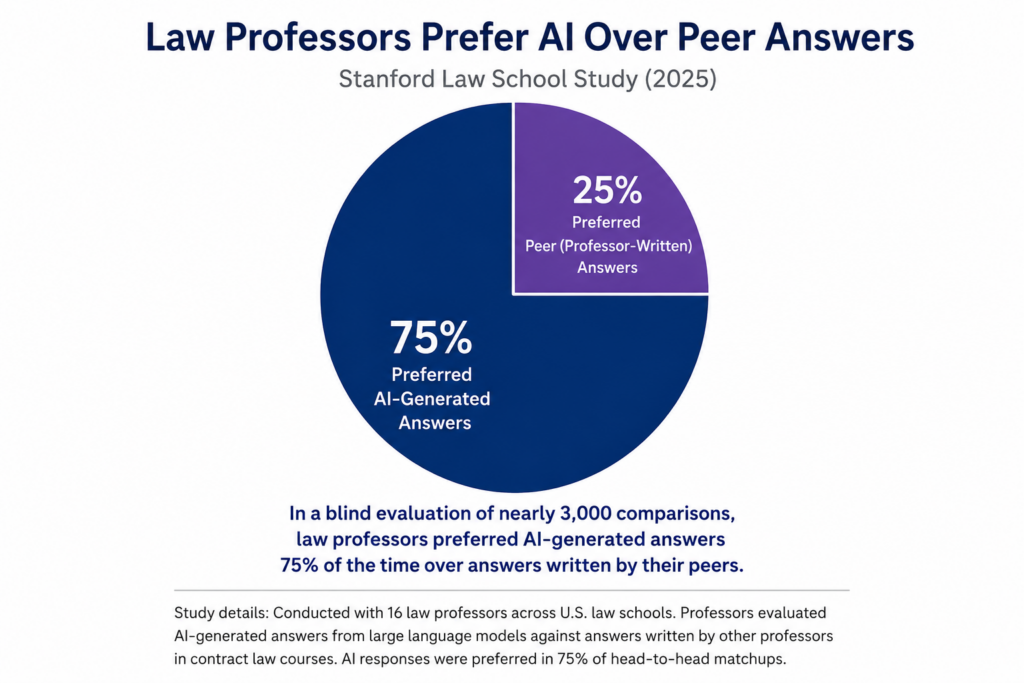
Source: Ashe, Stephanie, and Julian Nyarko. “AI Outperforms Law Professors in Stanford Law Study.” AI Outperforms Law Professors in Stanford Law Study, Stanford Law School, 1 June 2026, law.stanford.edu/press/ai-outperforms-law-professors-in-stanford-law-study/.
What concerns are educators discussing?
Despite its potential benefits, artificial intelligence raises important questions about academic integrity and student learning. Teachers and professors have expressed concern that some students may use AI to complete assignments without fully understanding the material. When this happens, AI may become a shortcut rather than a learning tool.
Many educators are also concerned about overreliance. If students turn to AI for every answer, they may spend less time developing skills such as writing, researching, analyzing evidence, and solving problems independently. These skills remain important regardless of how advanced technology becomes.
The conversation has expanded beyond individual classrooms. Several states are now considering policies that address how artificial intelligence should be used in schools, including guidance on AI literacy, student privacy, and responsible use. As AI becomes more common in education, schools are being challenged to balance innovation with accountability.
How are schools responding to AI?
Schools are responding to artificial intelligence in different ways. Some districts have introduced policies that limit AI use during exams and assessments, while others are focusing on teaching students how to use these tools responsibly.
The conversation has also reached state legislatures. Several states are considering laws related to artificial intelligence in education, including AI literacy requirements, student privacy protections, teacher training, and guidance for responsible classroom use.
The graphic below highlights several priorities states are discussing as they determine how AI should fit into education.
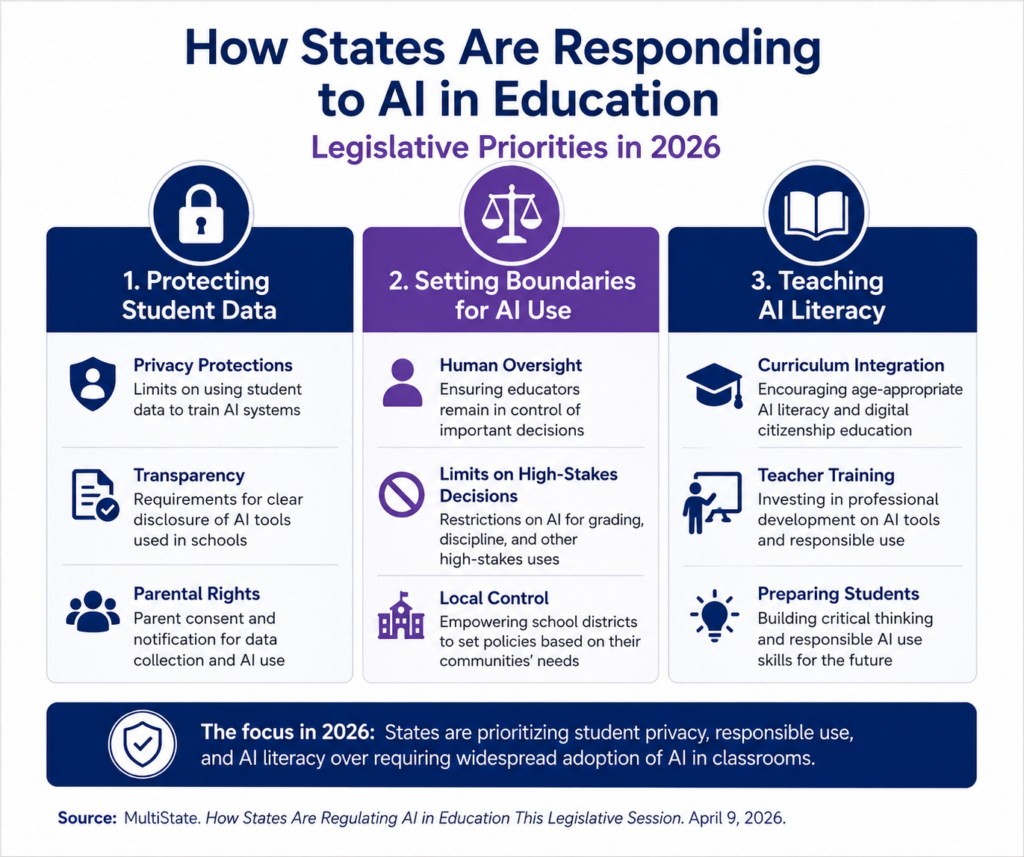
Source: Aaron, Izzy. “How States Are Regulating AI in Education This Legislative Session.” MultiState, 9 Apr. 2026, www.multistate.us/insider/2026/4/9/how-states-are-regulating-ai-in-education-this-legislative-session.
What does responsible use look like?
In general, responsible use means using AI to support learning rather than replace it. A student might ask AI to explain a difficult concept, generate practice questions, brainstorm ideas, or provide feedback on a rough draft. However, the student is still responsible for evaluating information, verifying sources, and developing their own understanding of the material.
A useful question to ask is: Could I explain this concept without AI’s help? If the answer is no, the technology may be doing the learning instead of the student.
Responsible use is not about avoiding AI altogether. It is about using AI in ways that strengthen critical thinking rather than replace it.
What is my perspective as a student?
As a software engineering student, I do not view artificial intelligence as inherently beneficial or detrimental. Like calculators, search engines, and other technologies before it, its value depends on how it is used.
The challenge is determining whether learning is actually taking place. A student can submit a completed assignment, solve a problem, or generate a written response with the help of AI. However, those results do not always demonstrate understanding and proficiency.
One solution I believe deserves more discussion is the use of verbal or conversation-based assessments. If a student can explain a concept, justify their reasoning, answer follow-up questions, and apply what they have learned in a new situation, they demonstrate a level of understanding that is difficult to fake. While written assignments will always have a place in education, combining them with discussion-based evaluations may help educators better measure critical thinking and genuine comprehension.
As AI continues to evolve, schools may need to rethink not only how students learn, but also how learning is assessed.
Where can you learn more?
Explore how AI raises questions about privacy, misinformation, deepfakes, and responsible technology use.